OpenstackLCM
Rationale
- Create a Kubernetes Operator able to orchestrate draining traffic, upgrading, testing, traffic rollout…
- The main lesson learned from this POC is the ability to use the helm rendering to provide a unified way of delivering scripts onto a platform and at runtime selectively decide which part of the chart to render according to the state of the service which lifecycle may not match exactly the lifecycle of a helm chart (i.e install, upgrade, rollback, delete).
The Argo team published since an new subproject to argoproj called argo-rollout which seems really promising.
Currently rely on replacing the standard StatefulSet by an Argo Rollout deployement object
Lessons Learned
Multi facet charts
- TBD
Traffic Draining
- TBD
ScaleUp / ScaleDown
- TBD
Documentation
Associated GIT Repos
Build oslc-operator
Build
git clone -b kube15 https://github.com/keleustes/oslc-operator.git
make
Branches
mastersupports kubernetes 1.14.x and helm 2.13.xkube15supports kubernetes 1.15.x and helm 2.14.x
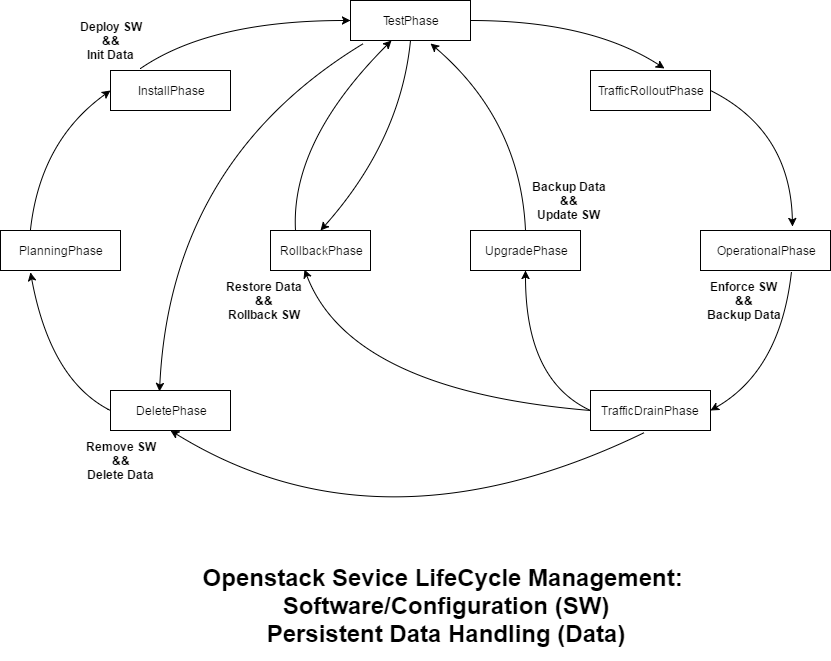
- Some transitions from one phase/stage to the other are autonomous:
- Start to test if install successful)
- xxx
- Some transitions from one phase/stage to the other but be triggered by Ops.
- For instance, the traffic will not be drained from a site unless Ops needs to perform operations:
- xxx
- Some of the lifecyle can be applied to one slice/shard of the a service. This is what happens during a blue-green update.
- xxx
- xxx
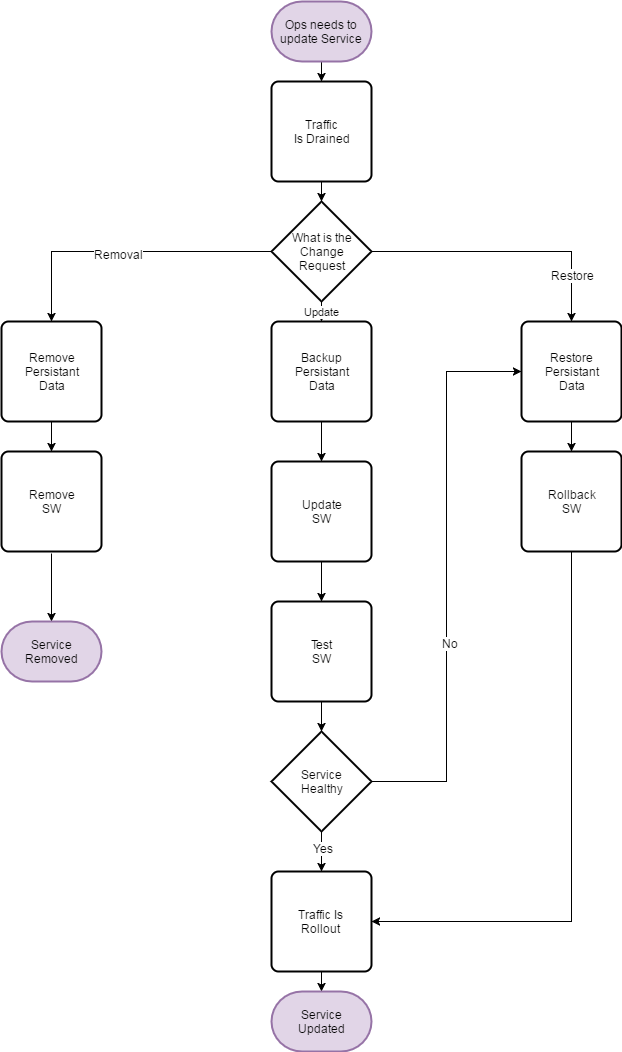
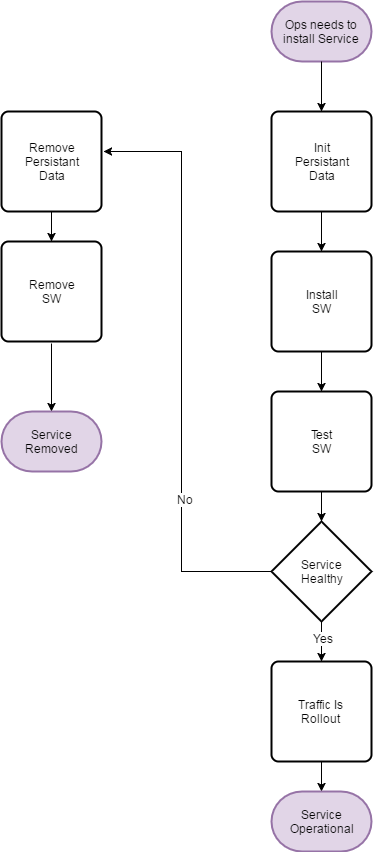
- Ops Team need to deploy a new service.
- If the service is unhealty, it gets removed.
- If the service is healty, it reaches the operational.
-
Ops Team need to:
- Use Case 1: remove a service.
- Use Case 2: update a service.
- Use Case 3: rollback a service.
-
Once the traffic is drain:
- Use Case 1: the service is removed.
- Use Case 2: the service is updated.
- Use Case 3: the service is rollback.
-
Once the update/rollback is performed, the traffic is rollout.
Oslc CRD
LifeCycle Modelisation
Design
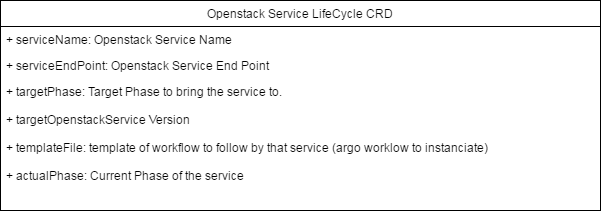
Oslc CRD
The CRD Oslc definition is available here:
- Its Spec which is update through kubectl: Spec
- Its Status which is updated by the operator and accessible through kubectl describe: Status
- Its definition made out of the two above components: Definition
- The yaml version of the CRD: Yaml
Oslc Controller
TBD
SubResources
The current PhaseCRD are currently standalone CRDs. This provides control to the phase-controller on those objects. At one point we will have to weight if we need to keep those CRDs or simply consider the Phase as nodes of an Argo Workflow.
Phase CRD
Phase Modelisation
Design
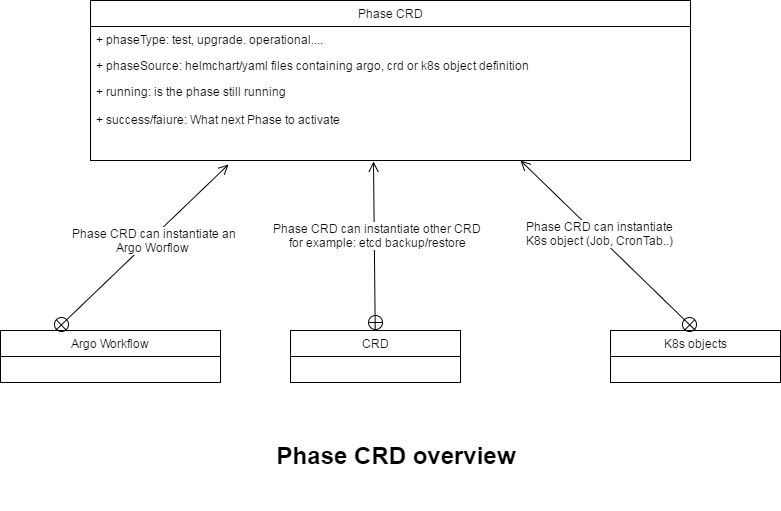
Phase CRD
The CRD Phase definition is available here:
- Its Spec which is update through kubectl: Spec
- Its Status which is updated by the operator and accessible through kubectl describe: Status
- Its definition made out of the two above components: Definition
- The yaml version of the CRD: Yaml
Phase Controller
The current POC created one CRD per phase. Most of the attributes of those CRDs are common. At one point we will have to weight the pros and cons of having only one PhaseCRD or one TestPhaseCRD, TrafficRolloutCRD.
LifeCycle
Openstack Service Lifecycle
Schema
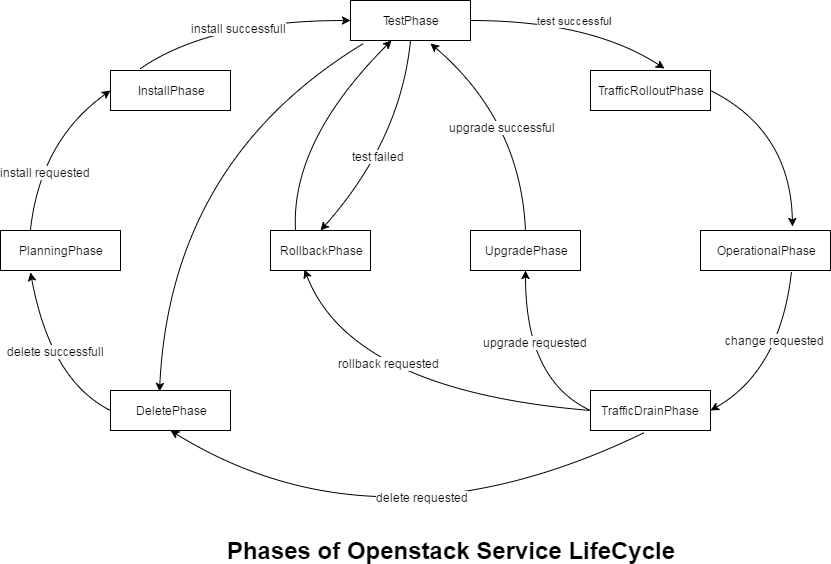
Rationale
SW & Data Handling
Schema
FlowCharts
Greenfield Deployment
Schema
Rationale
Brownfield Change
Schema